Our experienced team is pioneering precision medicine targeting neurodegeneration. Deep knowledge of the biological mechanisms found in neurodegenerative diseases led us to develop and optimize cutting-edge complementary discovery technology platforms, Morphomer® and SupraAntigen®. They are the engines that advance our industry-leading pipeline of active immunotherapies, antibodies, small molecules and diagnostics targeting proteinopathies of the central nervous system (CNS). Their agility allows for accelerated discovery and development of candidates targeting novel targets.
An integrated approach to CNS-specific therapies
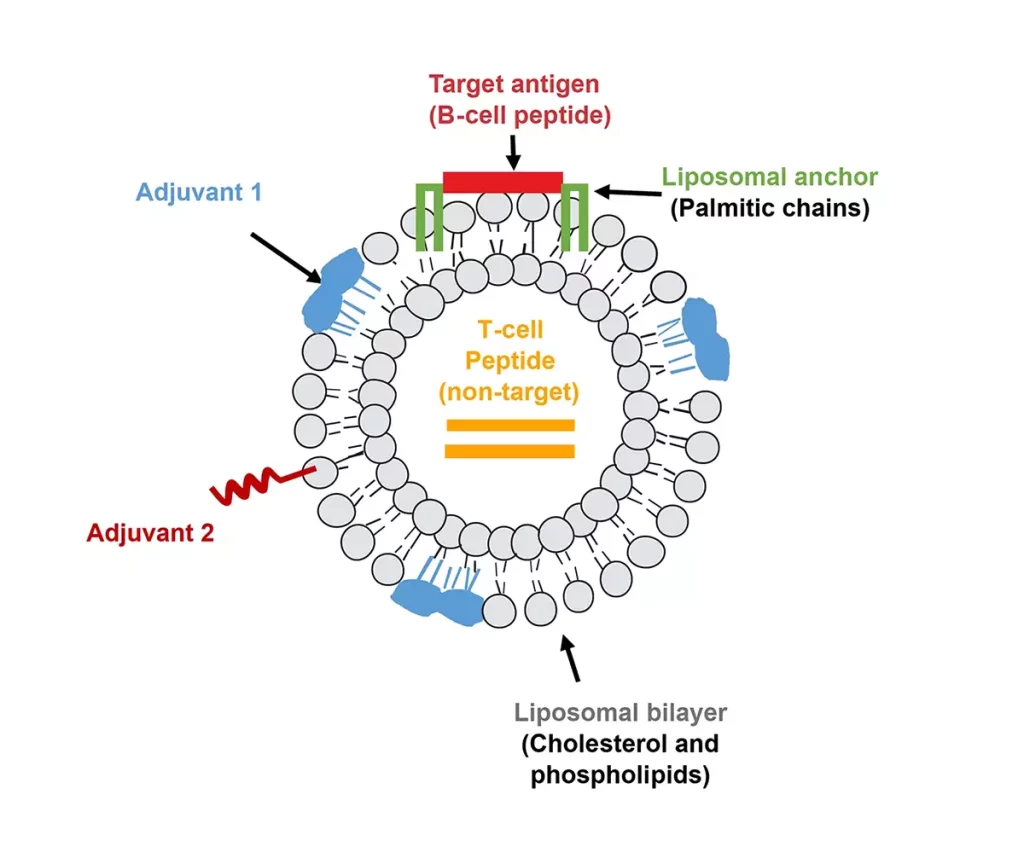
SupraAntigen® uses small spherical lipid bilayer vesicles called liposomes, to present specific antigens in a format designed to stimulate immune responses that generate conformation-specific, antigen-targeting antibodies. This is achieved by precisely controlling and stabilizing the spatial arrangement of the peptides on the surface of the liposome, allowing peptides to be presented to the immune system in a conformation-specific pathological configuration.
The SupraAntigen® technology can be used for active immunotherapies that stimulate the patient’s immune system to directly target pathological forms of misfolded proteins. An example of such an active immunotherapy is ACI-24, which targets not only oligomeric Abeta but also pyroglutamate Abeta (pyroGlu-Abeta) peptides. These peptides are truncated forms of the protein that are highly neurotoxic Abeta species found in brain amyloid plaques and believed to be key drivers of AD.
SupraAntigen® can also be used to generate monoclonal antibodies externally and these are then administered to patients by injection (passive immunization).
The Morphomer® platform combines small molecule chemistry with biological assays developed in-house, assisted by the latest information technology. This platform enables identification and development of small molecule Morphomers that target pathological protein aggregates in extra- and intracellular brain compartments.
The Morphomer® technology was used to identify and accelerate development of multiple diagnostic and drug-like CNS compounds advancing in our growing pipeline, including: PI-2620, a Tau-positron emission tomography (PET)-tracer in development with collaboration partner Life Molecular Imaging; ACI-12589, our wholly owned novel alpha-synuclein PET-tracer designed to detect alpha-synuclein in patients with Parkinson’s disease and other alpha-synucleinopathies; and ACI-3024, a small molecule Tau aggregation inhibitor partnered with Eli Lilly and Company.
The proprietary Morphomer® suite of quantitative and qualitative candidate-selection assays expedite the lead selection and optimization processes. They have been tailored over time to identify small molecules showing in vitro activity against selected targets and provide detailed insights into their mechanism of action while ranking compounds according to their performance. AC Immune established a large collection of rigorously validated, relevant translational preclinical models to evaluate drug-candidates’ effect on the processes of human disease in integrated biological systems.
Using these models, we can discover how a small molecule targets pathological protein aggregates and if it prevents seeding or spreading of proteinopathies. The Morphomer® platform has helped us develop a detailed mechanistic understanding of the interactions of small molecules with an ever-increasing number of hallmark proteins implicated in the pathology of neurodegenerative diseases. It is constantly adapted and improved, as our knowledge and computing power increase.
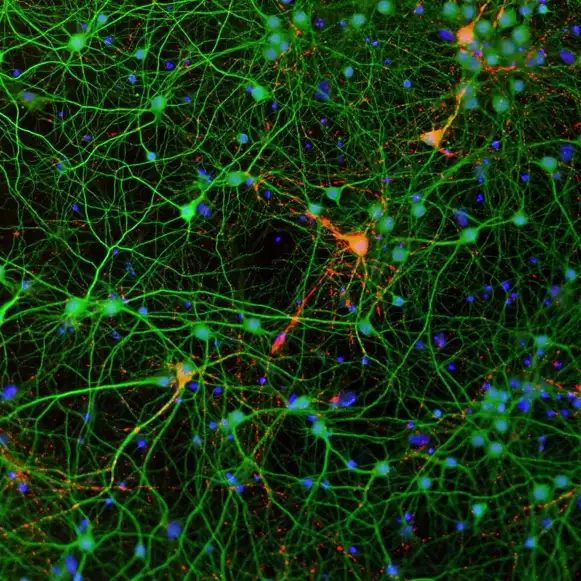
Immunostained a-syn aggregates (red) forming within cortical neurons (green) in culture.
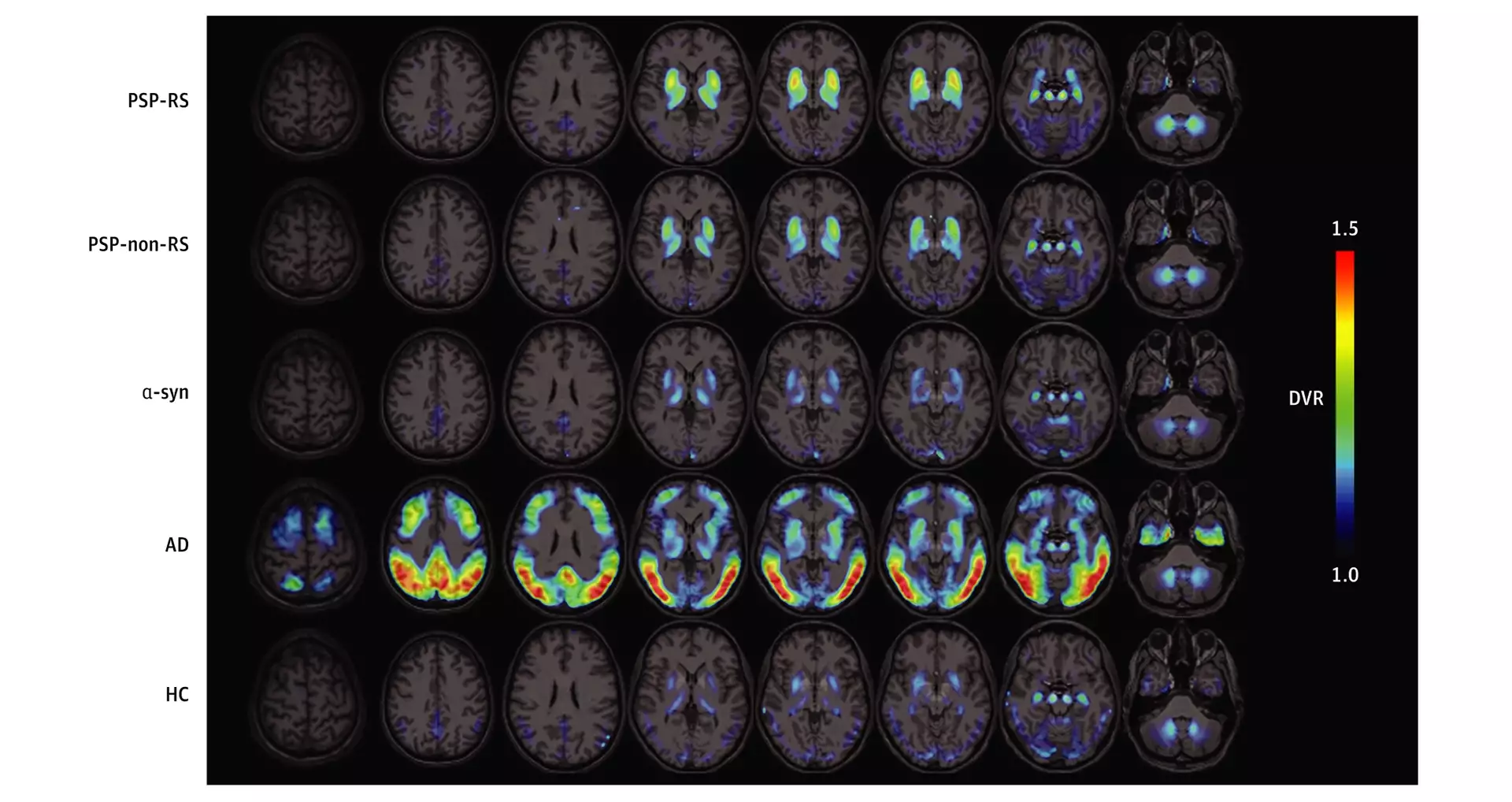
Average PI-2620 distribution volume ratio (DVR) binding maps in PSP-RS (Richardson syndrome progressive supranuclear palsy), PSP-non-RS (Progressive supranuclear palsy not of the Richardson syndrome type), a-syn (probable a-synucleinopathies), AD (Alzheimer’s disease), HC (healthy control). PI-2620 shows high selectivity for pathological Tau aggregates when comparing to HC or to a-synuclein subjects. Ref.: Brendel et al., JAMA Neurol., 2020